Table Of Contents
Why Is 70% Isopropyl Alcohol Used in Alcohol Prep Pads?
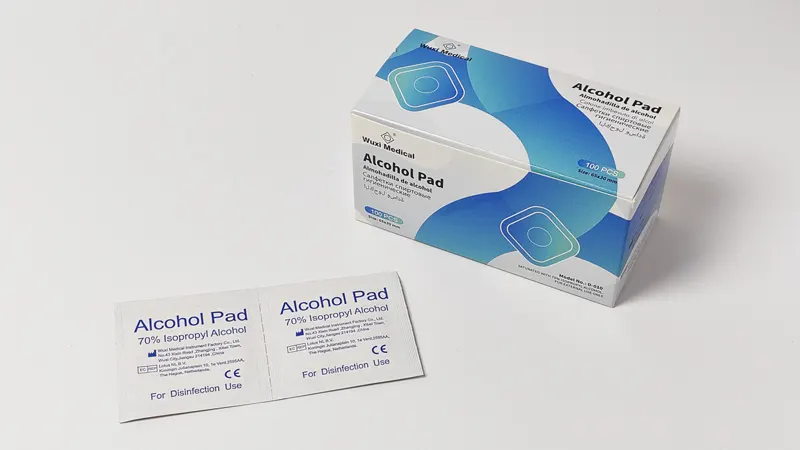
When you look at the label of an alcohol prep pad, 70% isopropyl alcohol is one of the most common concentrations you will find.
But why 70%?
If alcohol is responsible for antimicrobial activity, it may seem that a higher concentration should always be more effective. So why not use 90% or even 99% isopropyl alcohol?
The answer comes down to more than the amount of alcohol in the solution.
Alcohol concentration, water content, evaporation and contact time all affect how an alcohol-based product performs. For many alcohol prep pad applications, 70% isopropyl alcohol offers a practical balance between these factors.
Understanding this balance also helps explain why simply increasing the alcohol concentration does not necessarily make an alcohol swab a better product.
What Does 70% Isopropyl Alcohol Mean?
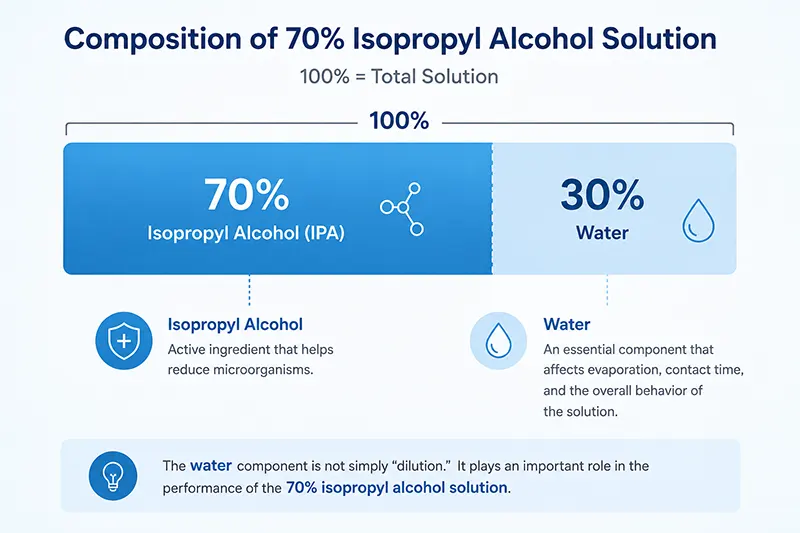
70% isopropyl alcohol, commonly called 70% IPA, generally refers to an isopropyl alcohol solution with a concentration of approximately 70% by volume.
The remaining portion is primarily water.
This point is important because the water is not simply an unwanted dilution.
The properties of an alcohol solution depend on the relationship between alcohol and water. Changing the concentration changes not only the amount of alcohol available, but also evaporation behavior, contact time and the way the solution interacts with microorganisms.
Why Isn’t 99% Isopropyl Alcohol Used Instead?
This is probably the first question that comes to mind.
A 99% IPA solution contains much more alcohol than a 70% solution. However, higher concentration does not automatically mean better antimicrobial performance.
One reason is the role of water.
Alcohol’s interaction with microorganisms involves processes such as membrane disruption and protein denaturation. The presence of water affects these processes and the overall behavior of the alcohol-water system.
Another factor is evaporation.
Highly concentrated IPA evaporates rapidly. In an alcohol prep pad, rapid evaporation can affect how long the solution remains wet on the intended surface.
This is why comparing 70% and 99% IPA simply by asking which one contains more alcohol misses an important part of the picture.
The better question is:
Which concentration is appropriate for the intended application?
The Role of Water in 70% IPA
Water plays a surprisingly important role in an alcohol solution.
It is tempting to think that adding water simply makes alcohol weaker. In reality, the water component affects several properties of the finished solution.
Slower evaporation
Compared with highly concentrated IPA, a 70% solution contains considerably more water.
This changes its evaporation characteristics and generally allows the solution to remain wet for longer.
For an alcohol swab, this can be important because the pad needs to deliver the solution to the intended area during use.
Contact time
The amount of time an alcohol solution remains in contact with a surface is an important consideration in its practical performance.
If a solution disappears almost immediately through evaporation, increasing the alcohol concentration does not necessarily provide an advantage.
The balance between alcohol concentration and evaporation therefore matters.
Alcohol-water interaction
The antimicrobial activity of alcohol is not simply determined by the number of alcohol molecules present.
The surrounding water affects the physical and chemical behavior of the solution and its interaction with microbial structures.
This is one reason why 70% IPA should not be viewed simply as 99% IPA with water added to make it weaker.
It is a different alcohol-water system with different properties.
70% vs. 90% vs. 99% Isopropyl Alcohol
Different IPA concentrations have different characteristics and applications.
[TABLE PLACEHOLDER]
| IPA Concentration | General Characteristics |
|---|---|
| 60% | Lower alcohol concentration; suitability depends on formulation and intended use |
| 70% | Commonly used balance of alcohol and water for many healthcare-related applications |
| 80% | Higher alcohol concentration with less water |
| 90% | High alcohol concentration and relatively rapid evaporation |
| 99% | Very high-purity IPA, widely used for technical, laboratory and industrial purposes |
This should not be interpreted as a ranking from “weak” to “strong.”
Different concentrations serve different purposes.
The important point is that more alcohol does not automatically make a product more suitable for every application.
Why 70% Works Well for Alcohol Prep Pads
Now we can return to the original question.
Why is 70% IPA so commonly used in alcohol prep pads?
Because an alcohol prep pad has practical requirements that go beyond the concentration printed on the label.
A pad needs to:
- Contain the specified amount of solution
- Remain sufficiently wet during use
- Release the solution effectively
- Maintain product integrity during storage
- Limit evaporation before the sachet is opened
70% IPA can provide a practical balance between alcohol content and water content for many such applications.
But the concentration is only one part of the finished product.
An Alcohol Pad Is More Than 70% IPA
A common mistake when comparing alcohol swabs is to focus entirely on the alcohol percentage.
In reality, the performance of a finished pad depends on several components.
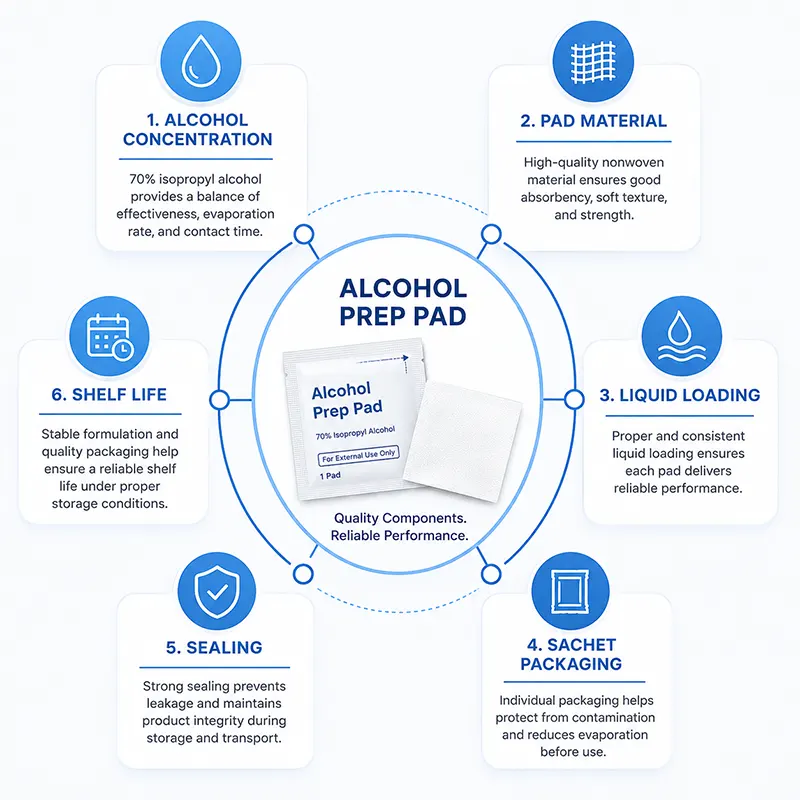
Pad material
The nonwoven substrate needs to absorb and release the solution effectively.
A pad that absorbs too much or releases too little may not provide the intended user experience.
Liquid loading
The amount of solution contained in each pad also matters.
Consistent liquid loading helps ensure that individual pads perform consistently.
Sachet packaging
Because IPA is volatile, individual packaging is important.
A properly sealed sachet helps limit evaporation and protects the pad before use.
Shelf life
The product should maintain its specified characteristics throughout its claimed shelf life under the recommended storage conditions.
This means that producing a good alcohol prep pad involves considerably more than simply selecting 70% IPA.
Why Individual Packaging Matters
An alcohol prep pad is designed to be used immediately after opening.
This makes packaging an important part of the product.
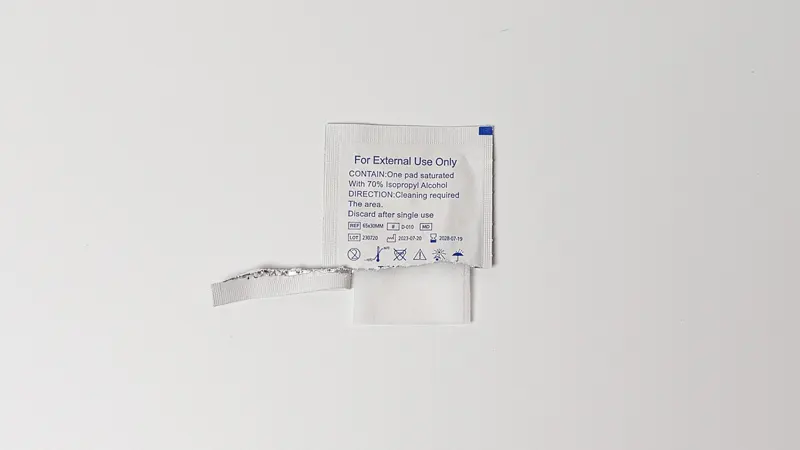
Individual packaging helps:
- Reduce evaporation before use
- Protect the pad from contamination
- Maintain the condition of the impregnated solution
- Provide convenient single-use packaging
For manufacturers and buyers, sachet quality is therefore not just a packaging issue. It is closely related to the stability and usability of the finished product.
Conclusion
So, why is 70% isopropyl alcohol used in alcohol prep pads?
The answer is not simply because 70% contains the “right amount” of alcohol.
It is about balance.
Alcohol concentration, water content, evaporation and contact time all influence how an alcohol solution behaves.
A higher concentration such as 90% or 99% is not automatically a better choice for every application. For many alcohol prep pad applications, 70% IPA offers a practical balance between alcohol and water.
And the alcohol concentration is only one part of the finished product.
The pad material, liquid loading, individual sachet, sealing quality and manufacturing controls all contribute to the final product.
That is why, when sourcing alcohol prep pads, it is worth looking beyond the number “70%” and considering the quality of the complete product.
70% Isopropyl Alcohol Prep Pads from a Manufacturer
Choosing 70% IPA is only the beginning.
A consistent alcohol prep pad requires control over the alcohol solution, nonwoven material, liquid loading, packaging and manufacturing process.
Wuxi Medical manufacture 70% Isopropyl Alcohol Prep Pads for distributors, importers and private-label customers.
Our alcohol pads can be supplied with individually sealed packaging and customized specifications according to the target market and application.
Click the image below to learn more about this product.
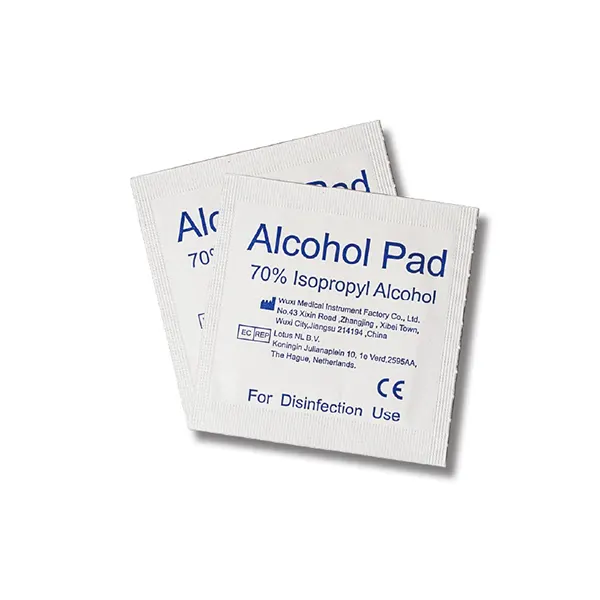
Looking for a 70% IPA Alcohol Pad Manufacturer?
We provide 70% isopropyl alcohol prep pads for professional and private-label applications, with OEM support for customized packaging and product specifications.
Learn more: https://wuxi-medical.com/alcohol-prep-pads/
Further Reading: Alcohol Concentration and Disinfection
For readers who would like to learn more about alcohol concentration, antimicrobial activity and the use of alcohol in healthcare settings, the following resources provide additional scientific and clinical information.
1. CDC — Chemical Disinfectants
Chemical Disinfectants: Alcohol
The U.S. Centers for Disease Control and Prevention (CDC) explains the antimicrobial properties of ethanol and isopropyl alcohol, including the commonly cited 60–90% concentration range and the role of water in alcohol’s antimicrobial activity.
Read the CDC guidance on chemical disinfectants
2. CDC — Disinfection of Medical Equipment
Environmental Services: Alcohol for Small-Surface Disinfection
CDC guidance discusses the use of ethyl or isopropyl alcohol at concentrations of 60–90% for certain small surfaces and also notes that alcohol evaporates rapidly, making contact time an important practical consideration.
Read the CDC guidance on environmental services
3. WHO — Guidelines on Hand Hygiene in Health Care
WHO Guidelines on Hand Hygiene in Health Care
The World Health Organization provides extensive scientific background on alcohol-based formulations, including alcohol concentration, water content and the differences between concentration expressed by volume and by weight.
Read the WHO Guidelines on Hand Hygiene in Health Care
4. CDC — Guideline for Disinfection and Sterilization in Healthcare Facilities
Guideline for Disinfection and Sterilization in Healthcare Facilities
This CDC guideline explains how alcohol concentration, water content, protein denaturation, and evaporation affect the antimicrobial activity of alcohols. It provides useful background for understanding why alcohol solutions are commonly used within a specific concentration range rather than simply at the highest possible concentration.